
Matter can exist in different forms called states of aggregation: solid, liquid, gas, and plasma. In this article we will talk about the changes of state of matter.
Now, a common question is:
What determines the state in which a substance exists?
The answer mainly depends on two key factors:
-
Temperature and pressure → which determine how much energy the particles have.
-
The nature of the substance → its molecular structure and the strength of intermolecular forces (attractive or repulsive).
👉 When temperature increases, particles move with more kinetic energy and tend to separate. Conversely, when the temperature decreases, particles lose energy and become more ordered.
-
At low temperatures, solids predominate, with tightly packed particles.
-
At intermediate temperatures, liquids appear, with particles that are close but still mobile.
-
At high temperatures, gases dominate, with particles widely spaced and free.
-
If we continue adding energy, gases can transform into plasma, a state where atoms lose electrons and free charges appear (like in the Sun).
With high pressure, particles are forced closer together; at low pressure, they spread out more.
A single substance can exist in different states depending on conditions. For example, water can be ice, liquid, or vapor, but it is always H₂O.
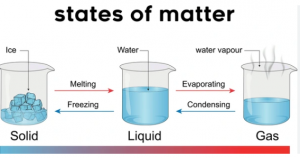
Main Changes of State and Everyday Examples
🔹 1. Melting (Fusion)
The change from solid to liquid.
Example: ice melting into cold water (at 0 °C or higher).
🔹 2. Solidification
The change from liquid to solid.
Example: water turning into ice cubes in the freezer (for water, this occurs below 0 °C, its melting point).
🔹 3. Vaporization
The change from liquid to gas, which can happen in two ways:
-
Evaporation: slow, occurring at the surface. Example: clothes drying on a line.
-
Boiling: rapid, occurring throughout the liquid. Example: water boiling at 100 °C.
🔹 4. Condensation
The change from gas to liquid.
Example: steam from a shower fogging up a mirror.
A variant of this process is liquefaction, where gas is converted to liquid artificially, usually by increasing pressure and lowering temperature. Examples include liquefied gases like liquid nitrogen or cryogenic liquids.
🔹 5. Sublimation
The change from solid to gas, without becoming liquid.
Examples:
-
Solid iodine, which turns into violet vapor when heated.
-
Dry ice (solid CO₂), which disappears as gas.
🔹 6. Deposition (Reverse Sublimation)
The change from gas to solid.
Example: frost forming on cold windows from water vapor.
🔹 7. Ionization
The change from gas to plasma.
Example: gas inside a fluorescent tube or plasma in the Sun.
🔹 8. Deionization (Recombination)
The change from plasma to gas.
Example: when a fluorescent tube is turned off, and the plasma returns to gas.
More Everyday Examples
-
Ice cream melting → melting
-
Ice cubes in the freezer → solidification
-
Boiling kettle → boiling
-
Fogged-up mirror → condensation
-
Iodine crystals turning into violet gas → sublimation
-
Frost on the window → deposition
I hope you found this post very useful!
For more details about melting and boiling points, check out this article on melting and boiling points (in Spanish).
-
Atkins, P., & de Paula, J. (2014). Physical Chemistry (10th Edition). Oxford University Press.
-
Chapters on properties of matter and phase changes.
-
Great for explaining solids, liquids, gases, and plasma with examples and particle theory.
-
-
Chang, R., & Goldsby, K. (2016). Chemistry (12th Edition). McGraw-Hill Education.
-
Includes practical sections and everyday examples of melting, vaporization, condensation, and sublimation.
-
Excellent for educational chemistry blog references.
-
List of Phase Changes Between States of Matter – ThoughtCo
